

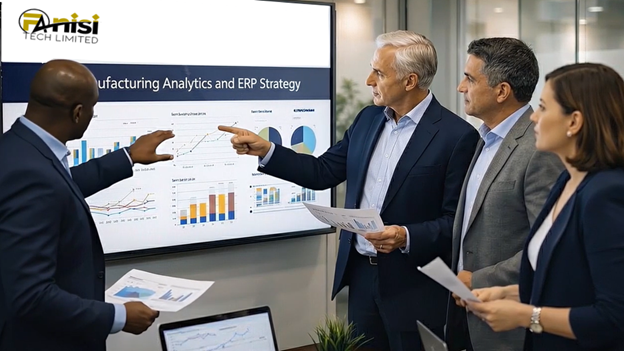
The Manufacturing Landscape in 2026
Three months into 2026, the divide between manufacturers thriving and those struggling has never been clearer. Kenyan and East African manufacturers who invested in modern ERP and analytics capabilities over the past 18-24 months are pulling ahead. Those still running fragmented systems are feeling the pressure-tighter margins, slower response times, and quality inconsistencies that cost them contracts.
The factories winning market share today aren't just producing goods. They're producing data, insights, and decisions faster than competitors.
Why Manufacturing Analytics Became Non-Negotiable in 2026
The conversation with manufacturers has shifted dramatically. In early 2025, we were still explaining why ERP modernization mattered. Today, the question is how fast can we catch up-or pull further ahead.
Here's what's defining the manufacturing landscape right now:
Real-time visibility is baseline. Enterprise buyers, regulators, and partners expect instant transparency into production status, quality metrics, and supply chain positioning. If you're still relying on spreadsheets and batch-reported dashboards, you're losing RFPs to competitors who can demonstrate live production data.
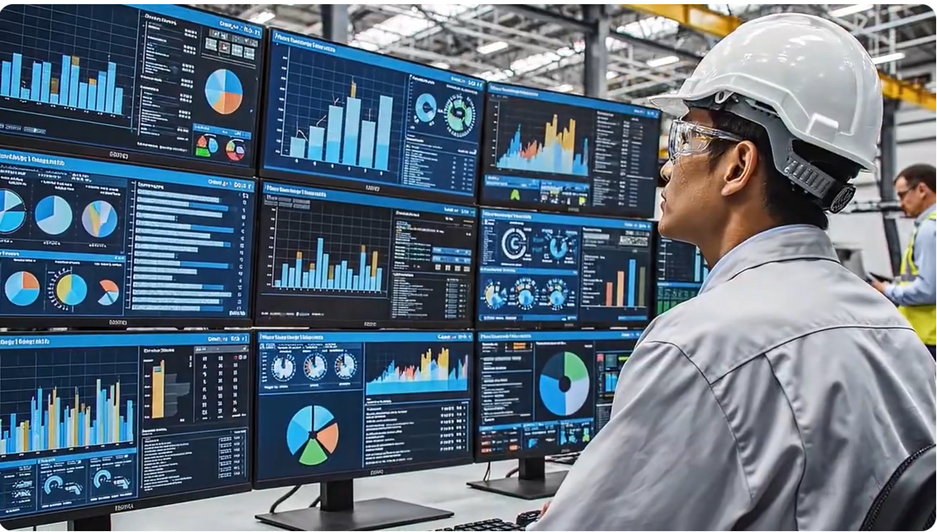
Predictive maintenance is now standard. The technology crossed from experimental to expected in late 2025. Leading manufacturers have moved from "fix it when it breaks" to predicting failures weeks in advance, slashing unplanned downtime by 40-60%.
AI-powered demand forecasting is reshaping inventory strategy. Machine learning models analyzing weather patterns, local events, seasonal trends, and macroeconomic signals are helping manufacturers right-size inventory in ways traditional ERP systems can't match.
Sustainability reporting is mandatory. ESG compliance moved from multinationals to regional enterprise requirements in early 2026. Manufacturers now need granular energy, water, and waste data flowing straight from shop floor systems into audit-ready reports.
Strategic Framework: The ERP Decisions That Matter Now
Most ERP consultants still pitch the same generic journey: assessment, selection, implementation, go-live. The reality for manufacturers in 2026 is more urgent-and requires a more sophisticated approach.
Data Architecture: The Foundation That Separates Leaders from Laggards
Before selecting modules or designing dashboards, the critical decision is your data architecture. Modern manufacturing analytics requires:
Unified namespace for operational data. Your PLCs, SCADA systems, MES layer, and ERP need to speak the same language. Consistent part numbers, work center definitions, and unit-of-measure standards across systems. Sounds basic, but we've seen multimillion-dollar projects stall because Plant A and Plant B used different coding schemes.
Edge-to-cloud strategy. Not everything belongs in the cloud-latency-sensitive quality controls need local processing. Smart manufacturers architect a hybrid approach: real-time decisions at the edge, pattern recognition and long-term analytics in the cloud.
Data lineage and governance. When your CFO asks how you calculated a specific cost variance, "the system generated it" isn't a good answer. Robust governance frameworks ensure traceability from source data to final metrics.
Analytics Maturity: Where Do You Stand in 2026?
We evaluate manufacturing analytics capabilities on a four-level maturity model:
Level 1: Descriptive (What happened?) Standard ERP reporting. Production volumes, material usage, variance reports. Manufacturers stuck here in Q1 2026 are already behind.
Level 2: Diagnostic (Why did it happen?) Root cause analysis capabilities. Drill-down from quality failures to specific batch parameters, operator shifts, or equipment conditions. Requires structured data models and cross-functional visibility.
Level 3: Predictive (What will happen?) Machine learning models forecasting demand, predicting equipment failures, or anticipating quality issues. This is where significant ROI materializes-preventing problems rather than reacting to them. In 2026, this is the competitive battleground.
Level 4: Prescriptive (What should we do?) Optimization engines recommending specific actions: reschedule this order, adjust this parameter, source from this supplier. The system doesn't just predict-it advises, and increasingly automates routine decisions. Early adopters in East Africa are hitting this level now.
Most East African enterprise manufacturers reached Level 2 in 2025. The competitive opportunity in 2026 is jumping to Level 3 before peers catch up.
Integration Strategy: The Make-or-Break Factor
ERP implementations fail more often from integration challenges than software bugs. For manufacturers, the critical integration points are:
ERP-MES Integration: Your shop floor execution system and ERP need real-time bidirectional data flow. Production orders down, actuals back up. Delays here create the classic "we don't know today's output until tomorrow morning" problem.
IoT and Sensor Data: Modern analytics requires high-velocity data from equipment sensors. Traditional ERP databases weren't designed for this. You need streaming data architectures that can ingest thousands of data points per second and distill them into meaningful metrics.
Supplier and Customer Systems: API-first integration with key suppliers for inventory visibility, with logistics providers for shipment tracking, and with major customers for demand signaling.
Financial and Operational Reconciliation: The perpetual tension between management reporting (financial view) and operational reporting (physical view). Smart ERP strategy unifies these rather than letting them diverge.
Industry-Specific Considerations in 2026
Process Manufacturing (Food, Beverage, Chemicals)
Recipe-based manufacturing requires different analytics approaches than discrete manufacturing. Yield analysis, lot traceability, and quality parameter correlation are critical. The ERP needs strong batch management and genealogy tracking-not all platforms handle this equally well.
Discrete Manufacturing (Automotive Parts, Electronics)
Complex bills of materials, engineering change management, and serial number traceability drive different requirements. Analytics focus on component availability, assembly efficiency, and warranty traceability.
Textiles and Apparel
Seasonal demand patterns, style-color-size complexity, and cut-to-order optimization create unique challenges. Forecasting accuracy and material utilization analytics deliver disproportionate value here.
The Change Management Reality
Technology is the easy part. The harder challenge is organizational:
Data literacy across levels. Your frontline supervisors need to interpret analytics, not just receive instructions. Training and change management investment often exceeds software licensing costs-and is more predictive of success.
Cross-functional alignment. Manufacturing analytics breaks down silos between production, quality, maintenance, and finance. That creates friction. Successful implementations have explicit governance models for who owns which decisions.
Performance management evolution. KPIs tied to old ways of working (cost per labor hour, machine utilization) often conflict with analytics-driven optimization (overall equipment effectiveness, throughput per constraint). Compensation and performance systems need to align with the new metrics.
Measuring ROI: The Metrics That Matter in 2026
We track four categories of impact for our clients:
Operational Efficiency: OEE improvement, throughput increases, changeover time reduction
Inventory Optimization: Working capital reduction, stockout rate improvement, obsolescence reduction
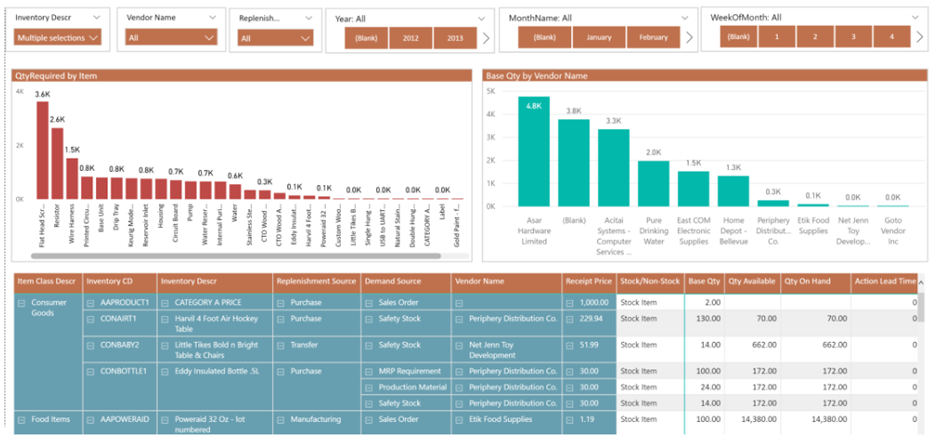
Quality and Compliance: Defect rate reduction, rework cost avoidance, audit preparation time
Maintenance and Reliability: Unplanned downtime reduction, maintenance cost optimization, asset life extension
The pattern we see: Level 1 and 2 analytics typically delivered 10-15% efficiency gains in 2024-2025. Level 3 predictive capabilities are doubling that impact within 12-18 months for manufacturers who moved early.
What FanisiTech Brings to the Table
FanisiTech Limited was built for this moment-helping East African manufacturers navigate ERP modernization and manufacturing analytics without the missteps that derail digital transformation projects.
We understand the local context. International ERP consultants often underestimate the realities of manufacturing in Kenya: intermittent power, complex regulatory environments (KEBS, KRA integration), supply chains that cross borders with different documentation requirements, and talent pools that need different training approaches. We've built our practice around these constraints.
We focus on outcomes, not just implementation. Our engagements are measured by production efficiency gains, inventory cost reductions, and quality improvements-not just whether the software got installed.
We bridge global technology with local execution. We bring enterprise-grade ERP and analytics platforms that compete with anything available globally, but we implement and support them with teams who understand the nuances of operating in Nairobi, Mombasa, Kampala, and beyond.
We specialize in manufacturing. Generic ERP implementers apply the same playbook to banks, retailers, and factories. We focus exclusively on manufacturing, which means we understand OEE, traceability, and constraint theory-not just general ledger and procurement.
The Rest of 2026: Closing the Gap or Extending the Lead
We're already seeing divergence. Manufacturers who invested in connected, intelligent ERP systems in 2024-2025 are extending their lead in Q1 2026. Those still running on legacy infrastructure are getting squeezed on margins, delivery times, and quality consistency-often losing contracts to more agile competitors.
The technology has matured. Cloud-based ERP solutions have reduced upfront capital requirements. Implementation methodologies have gotten sharper. And partners like FanisiTech have developed the specialized expertise to deliver rapid results in the East African context.
For enterprise manufacturers in Kenya and the broader region, the question in March 2026 isn't whether to invest in manufacturing analytics and modern ERP strategy. It's whether you can afford to wait another quarter while competitors pull further ahead.
FanisiTech Limited partners with ambitious manufacturers ready to close the gap-or extend their lead. If you're evaluating ERP modernization, assessing your analytics maturity, or wondering what a Level 3 predictive capability could look like in your operation, let's talk.
To find us, visit our website https://fanisitech.com/, call our offices (+254743313103), visit our main office [Office Number 718, 7th Floor, KU PLAZA, Haile Sallassie Avenue, Nairobi CBD], or email us on info@fanisitech.com to schedule a FREE DEMO.
Latest Comments
No comments yet for this post. Be the first to comment
Comment on the blog "Manufacturing Analytics and ERP Strategy for Businesses in …"