

Running a growing business is exciting, but it also comes with a unique set of headaches. Orders start piling up, spreadsheets multiply, and different departments seem to be working from different versions of the truth. If any of this sounds familiar, your business may have outgrown its current systems and processes.
This is usually the point where an Enterprise Resource Planning (ERP) system becomes not just useful, but necessary. At FanisiTech Limited, we work with businesses every day that are trying to figure out whether it's time to invest in an ERP system or whether they can continue managing with what they already have.
In this article, we walk you through five clear signs that your business needs an ERP system, and what to do about it.
What Is an ERP System, Really?
Before we get into the signs, let's quickly clarify what an ERP system actually is.
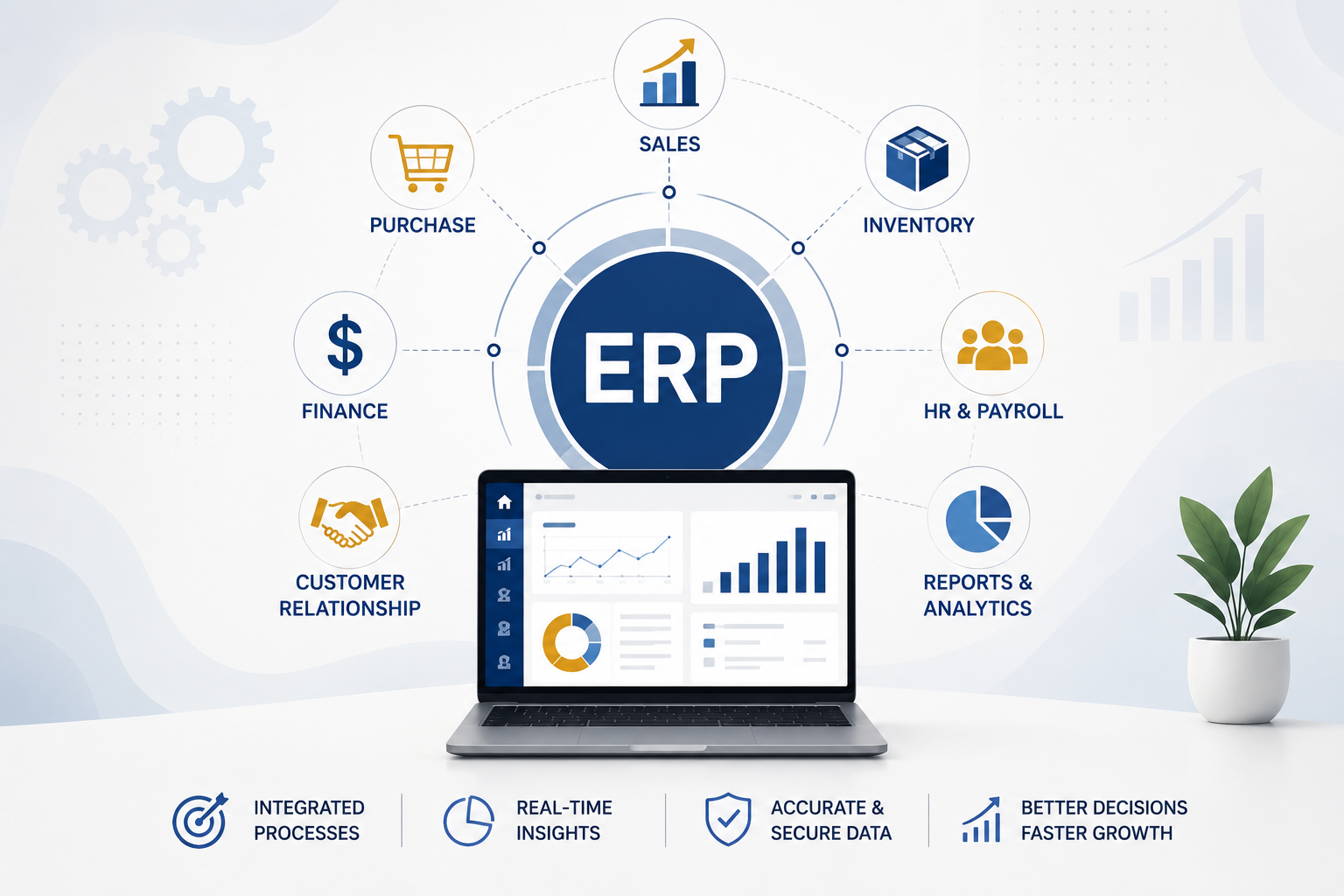
ERP stands for Enterprise Resource Planning. In simple terms, it is a type of software that brings together the different functions of a business, such as finance, inventory, sales, human resources, procurement, and customer management, into one connected system.
Instead of having separate tools that don't talk to each other, an ERP system creates a single source of truth. Everyone in the organization, from the accountant to the warehouse manager, works from the same real-time data.
Think of it like this: if your business were a human body, an ERP system would be the central nervous system, making sure every part communicates with every other part instantly and accurately.
Now, let's look at the signs that tell you it might be time to bring this kind of system into your business.
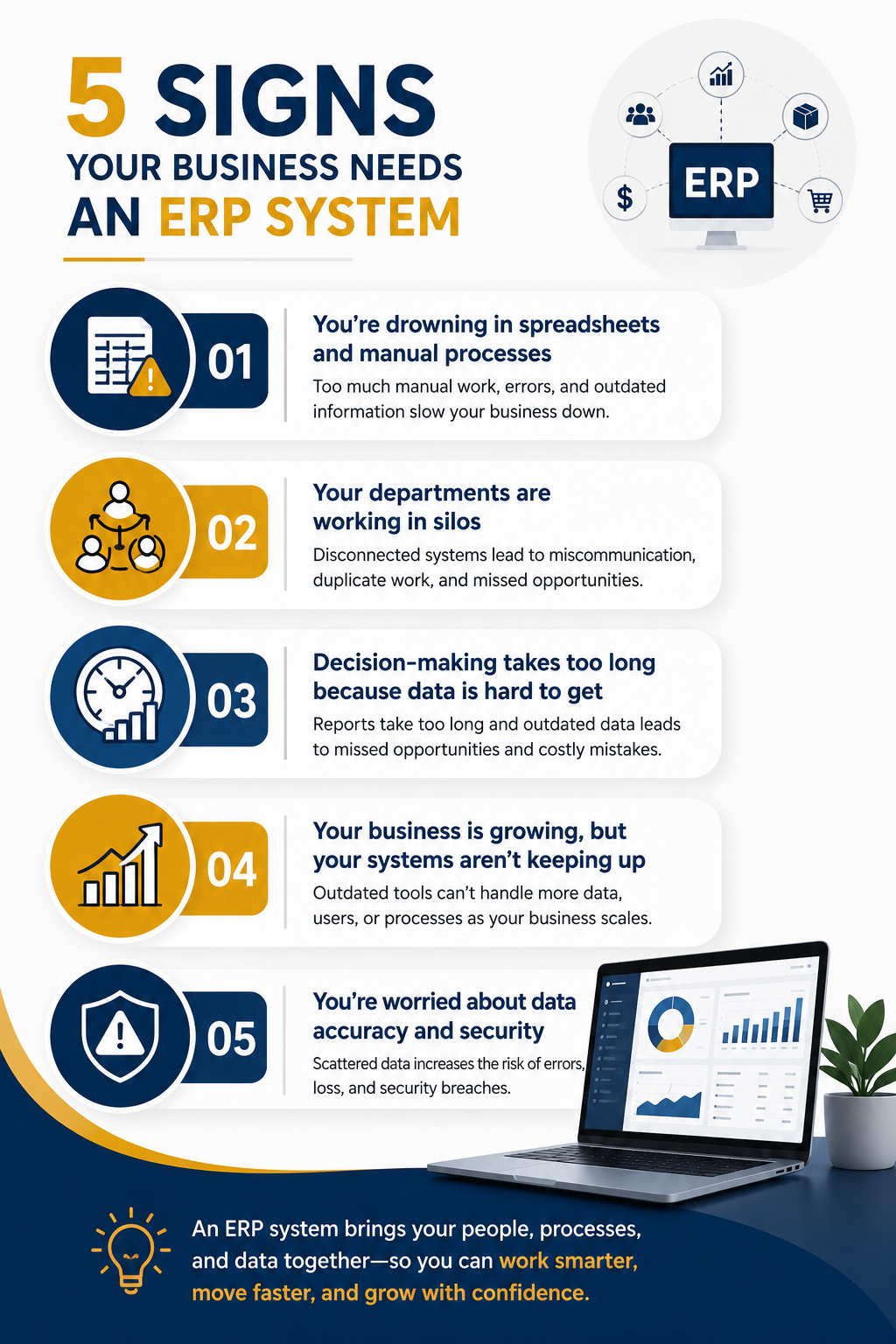
Sign 1: You're Drowning in Spreadsheets and Manual Processes
This is by far the most common sign we see at FanisiTech Limited.
Many businesses start out with Excel spreadsheets, and for a while, this works perfectly well. But as the business grows, so does the number of spreadsheets. Soon, you have one spreadsheet for inventory, another for sales, another for payroll, and another for customer records. Each department maintains its own version, and none of them are connected.
The problems this creates are numerous:
- Data has to be manually copied from one spreadsheet to another, which takes time and introduces errors.
- Two people may be working with different, outdated versions of the same file.
- There is no easy way to get a complete, real-time picture of the business.
- Simple tasks like generating a report can take hours instead of minutes.
If your team spends more time managing spreadsheets than actually running the business, that is a strong signal that you need a system that automates this work and keeps everything in one place.
An ERP system replaces these scattered spreadsheets with a single platform where data is entered once and automatically updates across every relevant department. This alone can save businesses dozens of hours every month.
Sign 2: Your Departments Are Working in Silos
In many growing businesses, departments unintentionally become isolated islands. The sales team has its own records. The finance team has its own books. The warehouse team tracks stock in its own way. Everyone is busy, but nobody has the full picture.
This creates a number of frustrating situations:
- The sales team promises a customer a product that is actually out of stock, because they didn't know inventory levels had changed.
- Finance struggles to reconcile invoices because they don't have visibility into what was actually delivered.
- Management cannot get a single report that combines sales, expenses, and stock levels without asking three different people for three different files.
This lack of communication between departments does not usually happen because people are careless. It happens because the tools they are using were never designed to share information with each other.
An ERP system solves this by giving every department access to the same central database. When the warehouse updates stock levels, sales sees it immediately. When finance records a payment, it reflects everywhere it needs to. This breaks down the silos and creates a business that operates as one connected unit rather than several disconnected departments.
Sign 3: Decision-Making Takes Too Long Because Data Is Hard to Get
Ask yourself this question: if your manager asked you right now for last month's total sales, current stock levels, and outstanding customer payments, how long would it take you to compile that information?
If the answer is "a few days" instead of "a few minutes," this is a serious red flag.
In today's business environment, speed matters. Opportunities and problems both move fast, and leaders need accurate information immediately in order to make good decisions. When your data lives in scattered files, disconnected systems, or people's memory, you lose valuable time chasing numbers instead of acting on them.
Common symptoms of this problem include:
- Reports that require someone to manually gather data from multiple sources before they can even begin building the report.
- Management making decisions based on outdated or incomplete information because up-to-date numbers simply aren't available fast enough.
- Different people giving different answers to the same question, because their data sources don't match.
An ERP system gives you real-time dashboards and reports that pull directly from live data. Instead of waiting days for a report, decision-makers can see accurate figures instantly, whenever they need them. This turns decision-making from a slow, frustrating process into a fast, confident one.
Sign 4: Your Business Is Growing, But Your Systems Aren't Keeping Up
Growth is a good problem to have, but it is still a problem if your current tools cannot handle it.
Many small businesses start with basic tools, a simple accounting package, a manual inventory list, a handful of spreadsheets, and this works fine when the business is small. But as the business expands into new locations, adds more products, hires more staff, or serves more customers, these basic tools begin to break down.
Signs that your systems are not scaling with your business include:
- Your accounting software constantly crashes or slows down because it's handling more data than it was built for.
- You cannot easily add a new branch, warehouse, or product line into your current system without a messy workaround.
- Staff have created their own unofficial tools and processes just to cope, meaning the business now runs on a patchwork of solutions nobody fully understands.
- It becomes harder to maintain consistency in pricing, processes, and customer service as you grow.
An ERP system is built specifically to scale with your business. Whether you are adding a new branch, expanding your product catalogue, or entering a new market, a good ERP system can grow alongside you without requiring you to start from scratch. This makes it a long-term investment rather than another tool you will outgrow in a year or two.
Sign 5: You Have Little to No Visibility Into Your Business Performance
This sign is closely related to the others, but it deserves its own spotlight because of how critical it is.
Many business owners we speak with at FanisiTech Limited describe a similar feeling: they are working extremely hard, sales appear to be happening, yet they are not entirely sure whether the business is actually profitable, which products are performing well, or where money is being lost.
This lack of visibility can show up in several ways:
- You don't have a clear, real-time view of cash flow.
- You cannot easily tell which products or services are your most profitable.
- Inventory discrepancies happen often, and nobody can explain exactly where the gap occurred.
- You find out about problems, like a supplier delay or a drop in sales, weeks after they have already affected the business.
Running a business without clear visibility is a bit like driving at night without headlights. You might get where you're going, but you are taking on unnecessary risk the entire way.
An ERP system acts as your headlights. It gives you accurate, real-time visibility into every part of your business, sales, expenses, inventory, staff productivity, and more, so you can catch problems early and make informed decisions before small issues become big ones.
So, What Should You Do If You Recognize These Signs?
If you read through this list and found yourself nodding along to two or more of these signs, it's a strong indication that your business is ready for an ERP system.
The good news is that adopting an ERP system does not have to be complicated or overwhelming. Here are a few steps to help you get started:
1. Start by identifying your biggest pain points. Is it inventory management? Financial reporting? Communication between departments? Knowing your biggest challenge will help you choose an ERP system that addresses it directly.
2. Involve your team early. The people who will use the system every day should have a voice in choosing it. Their input will help you select a system that fits how your business actually works.
3. Choose a system that fits your business size and industry. Not every ERP system is built the same way. Some are designed for large corporations, while others are built specifically for small and medium-sized businesses. Choose one that matches your scale and industry needs.
4. Plan for proper implementation and training. An ERP system is only as good as how well it is implemented. Proper setup, data migration, and staff training are essential for a smooth transition.
5. Work with experienced partners. Implementing an ERP system is a significant step, and having the right guidance makes a big difference. This is where a knowledgeable partner can help you avoid common pitfalls and get the most value out of your investment.
Final Thoughts
Every business reaches a point where the tools that once worked perfectly well start to hold it back. Spreadsheets become unmanageable, departments stop communicating effectively, decisions slow down, growth outpaces your systems, and visibility into performance disappears.
If you're seeing any of these five signs in your own business, it may be time to consider an ERP system. It is not just a piece of software, it is a foundation that allows your business to run more efficiently, make better decisions, and grow with confidence.
At FanisiTech Limited, we help businesses identify the right systems and solutions for their specific needs, guiding them through every step of the process, from choosing the right ERP system to implementing it successfully. If you would like to discuss whether an ERP system is right for your business, our team is ready to help.
Your business has worked hard to grow this far. Give it the systems it deserves to keep growing well.
Latest Comments
No comments yet for this post. Be the first to comment
Comment on the blog "5 Signs Your Business Needs an ERP System"